![{INAF/IASFMI logos]](Images/logo_iasf_crop.jpg)

Historical Note
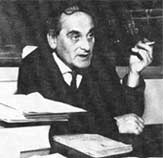 Giuseppe Paolo Stanislao Occhialini (Beppo) is at the origin of
IASF-MI. After his contributions to the discovery of the
positron in the 1930s and of the pion in the 1940s, while working in
England, Occhialini came back to Italy as Full Professor of Physics at
Genoa University and, subsequently, at Milan University. In Milan,
Occhialini continued pursuing his interests in elementary particles and
set up a nuclear physics group which used cosmic rays as a natural
accelerator that allowed to study high energy nuclear reaction products.
This group finally became the Milan Section of INFN
(Istituto Nazionale di Fisica Nucleare). In the 1960s, Occhialini and his
group developed an interest in cosmic ray studies per se, mainly electrons
and gamma-rays. He succeeded in obtaining funds from CNR
and started the era of space projects in Italy, by participating with
experiments in the first ESRO (now ESA) satellites and fathering
COS-B, the first European survey satellite to explore the
gamma-ray sky. In order to support these activities, Occhialini gathered
around him a group of young graduate students who, together with senior
scientists and expert engineers, made up the Cosmic Ray
Group, that had the joking motto Join the Group, Will Travel
which is exactly what happened, because of the many international
connections and collaborations he had set up.
Giuseppe Paolo Stanislao Occhialini (Beppo) is at the origin of
IASF-MI. After his contributions to the discovery of the
positron in the 1930s and of the pion in the 1940s, while working in
England, Occhialini came back to Italy as Full Professor of Physics at
Genoa University and, subsequently, at Milan University. In Milan,
Occhialini continued pursuing his interests in elementary particles and
set up a nuclear physics group which used cosmic rays as a natural
accelerator that allowed to study high energy nuclear reaction products.
This group finally became the Milan Section of INFN
(Istituto Nazionale di Fisica Nucleare). In the 1960s, Occhialini and his
group developed an interest in cosmic ray studies per se, mainly electrons
and gamma-rays. He succeeded in obtaining funds from CNR
and started the era of space projects in Italy, by participating with
experiments in the first ESRO (now ESA) satellites and fathering
COS-B, the first European survey satellite to explore the
gamma-ray sky. In order to support these activities, Occhialini gathered
around him a group of young graduate students who, together with senior
scientists and expert engineers, made up the Cosmic Ray
Group, that had the joking motto Join the Group, Will Travel
which is exactly what happened, because of the many international
connections and collaborations he had set up.
 At the end of 1969,
the Group was transformed into a CNR Institute, assuming
the name of Istituto di Fisica Cosmica e Tecnologie
Relative (IFCTR). Occhialini was appointed Director of the
Institute, which was provisionally hosted in the University Physics
Department. Those were heroic times, in which bureaucracy seemed not to
exist and everything was considered possible. Experimental space research
was the main activity of the Institute, until, in the mid-1970s it was
decided that X-ray and IR astronomy were also very promising and steps
were taken, eventually leading to the construction of the
TIRGO telescope.
At the end of 1969,
the Group was transformed into a CNR Institute, assuming
the name of Istituto di Fisica Cosmica e Tecnologie
Relative (IFCTR). Occhialini was appointed Director of the
Institute, which was provisionally hosted in the University Physics
Department. Those were heroic times, in which bureaucracy seemed not to
exist and everything was considered possible. Experimental space research
was the main activity of the Institute, until, in the mid-1970s it was
decided that X-ray and IR astronomy were also very promising and steps
were taken, eventually leading to the construction of the
TIRGO telescope.
 Toward the end
of the decade, the Group had grown in size while room in the Physics
Department was scarce. People were split around in various locations in
town, including the Occhialini's apartment, which had become his office,
and where anybody could spend generous amounts of time, especially at
night hours (but at supper time you would be generously fed). Normal times
were coming, and these brought new office and laboratory space in a CNR
owned building, via Bassini 15, where IASF-MI is now.
With Occhialini's retirement age, a new Director was also appointed,
Giuliano Boella, an electronics professor at the University who was in the
group since the beginning. Space research remained the main activity, but
researchers in the Institute developed also interests in radioastronomy,
optical astronomy and high energy astrophysics, leading in the end to the
several activities, still being pursued nowadays. But the staff did not
increase anymore, and only the computing department (now a separate
Institute) saw some development.
Toward the end
of the decade, the Group had grown in size while room in the Physics
Department was scarce. People were split around in various locations in
town, including the Occhialini's apartment, which had become his office,
and where anybody could spend generous amounts of time, especially at
night hours (but at supper time you would be generously fed). Normal times
were coming, and these brought new office and laboratory space in a CNR
owned building, via Bassini 15, where IASF-MI is now.
With Occhialini's retirement age, a new Director was also appointed,
Giuliano Boella, an electronics professor at the University who was in the
group since the beginning. Space research remained the main activity, but
researchers in the Institute developed also interests in radioastronomy,
optical astronomy and high energy astrophysics, leading in the end to the
several activities, still being pursued nowadays. But the staff did not
increase anymore, and only the computing department (now a separate
Institute) saw some development.
Then, in 1994, because of health problems, Boella resigned and Enrico G. Tanzi, one of the senior researchers in the Institute, was appointed as Director. His main effort was to rationalize the Institute scientific activity, stimulating experimental research and trying to use all possible means to cover the staff vacancies and attract Ph.D. students and post-docs. Unfortunately, Tanzi's directorship lasted only a few years, and, at his sudden death in 1998, Gabriele Villa, another senior researcher in the Institute, was appointed as his successor. The last years of the twentieth century saw the development of the VIRMOS project, a French-Italian collaboration (with a strong IFCTR participation), which built the VIMOS spectrograph for the VLT, and of AGILE, an Italian gamma-ray satellite due to be launched in 2005, mainly designed and developed in the Institute.
The new millennium saw a first CNR reform, whereby IFCTR and three other astrophysical Institutes (ITESRE in Bologna, IAS in Rome, and IFCAI in Palermo) were merged into IASF with headquarters in Rome, and IFCTR became the IASF Milan Section. The new 2003 reform, involving both CNR and INAF, has incorporated the three CNR astronomical Institutes (IASF, IRA and IFSI) into the reformed INAF as of January 2005. On September 1, 2005, the Milan Section of IASF has become an INAF Research structure with name of IASF Milano.
